
Basis Weight Measurement: The Right Technology for Every Application
Non-contact measurement of basis weight / grammage of continuous web processes
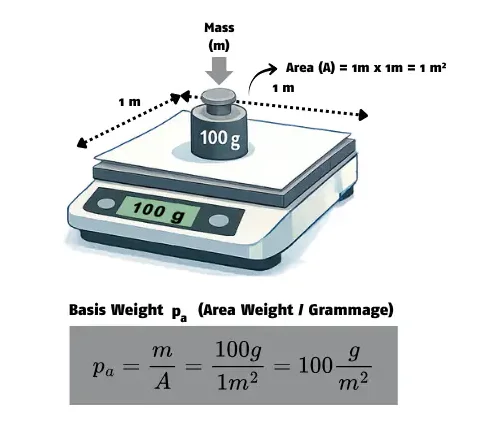
Basis weight – often referred to as grammage – is one of the most important quality parameters for web-based materials. It describes the mass of a material per unit area and is typically expressed in g/m² (or, in the US system, in oz/yd²). The basis weight is calculated using the formula: Basis weight (pa) = Weight (m) / Area (A), i.e. pa = m/A.
In virtually all continuous manufacturing processes – from textiles and nonwovens to coatings, films, composites, battery electrodes and battery separators – basis weight has a direct influence on product performance, material consumption and overall production efficiency.
Precise inline basis weight measurement enables continuous web quality control during the manufacturing process. Modern measurement systems monitor basis weight contactlessly and in real time, providing valuable data for process control, basis weight control and automated profile control. As a result, manufacturers can reduce raw material consumption, minimise waste and ensure consistently high product quality.
👉 Are you a Pro? Go straight to products and sensors »
Since different materials exhibit different physical properties, there is no universal measurement technology suitable for every application. Instead, various measurement principles are used depending on the material structure, layer composition, basis weight range and process requirements. Selecting the most suitable technology depends on factors such as material type, production stage, required accuracy and additional quality parameters.

Qualiscan QMS -12 Bestseller
Traversing quality control system
Web process control
The Qualiscan QMS is a modular system for measuring, logging and controlling critical process parameters over the entire width of the product, including basis weight,…
Show details

Optipac VMC -15
Modular process control system
Optimizes finishing
The Orthopac VMC is a modular process control system for textile refinement. It optimises drying or fixing processes as well as the processes all about the stenter. The…
Show details

Famacont PMC -15
Control of thread density / course density / basis weight
Optolectronic sensor / camera sensor
The Famacont PMC determines the thread density by means of a non-contacting, optoelectronic or imaging process. With the optoelectronic process individual…
Show details

Gravimat FMI/DFI
Measurement of basis weight (mass per unit area) / thickness /density
Transmission of beta rays
The weight monitoring and control system measures the weight continuously, without contact, destruction-free and on moving product. The measurement is based…
Show details

Gravimax MMX
Measurement of basis weight / component composition
X-ray absorption, X-ray backscatter: basis weight & component measurement
The Gravimax-MMX-R platform features X-ray sensors (absorption and backscatter) for measuring basis weight…
Show details

Gravimat FMX-T
Measurement of basis weight (mass per unit area) / thickness / density
Transmission of X-rays
The Gravimat FMX-T permits the contactless and traversing measurement of basis weight (grammage) / thickness of the running product webs over the entire…
Show details

Infralot IMF
Measurement of moisture / organic compound
Absorption/reflexion of infrared light
Infralot IMF uses optical evaluation of the absorbed/reflected light energy in the near-infrared range to continuously measure and control…
Show details

Infrascope NIR
Measurement of basis weight (mass per unit area) / moisture
Absorption of infrared light
The Infrascope NIR monitors the absorption of infrared energy of all components on or in the web in the near infrared range. Measuring over the entire…
Show details

Famacont PMC CK
Control of thread density / course density / basis weight
Camera sensor
A high-resolution camera determines the angle of the weft thread of a running textile web.
Show details
Famacont PMC
Control of thread density / course density / basis weight
Optolectronic sensor / camera sensor
The Famacont PMC determines the thread density by means of a non-contacting, optoelectronic or imaging process. With the optoelectronic process…
Show details
Selecting the Right Technology for Your Process
The choice of measurement technology ultimately depends on the material, production process and quality requirements. While beta transmission and X-ray technologies provide highly accurate and direct basis weight measurement, NIR-based systems offer additional insights into moisture content, coating weight and material composition. Optical systems complement these technologies, particularly within the textile industry, by providing detailed information about fabric structure and production quality.
Modern systems for inline basis weight measurement, thickness measurement, process control, basis weight control and profile control have become indispensable tools for manufacturers of web-based materials. By selecting the most appropriate technology, producers can stabilise processes, reduce raw material costs, minimise waste and consistently achieve the highest quality standards while improving both productivity and sustainability.